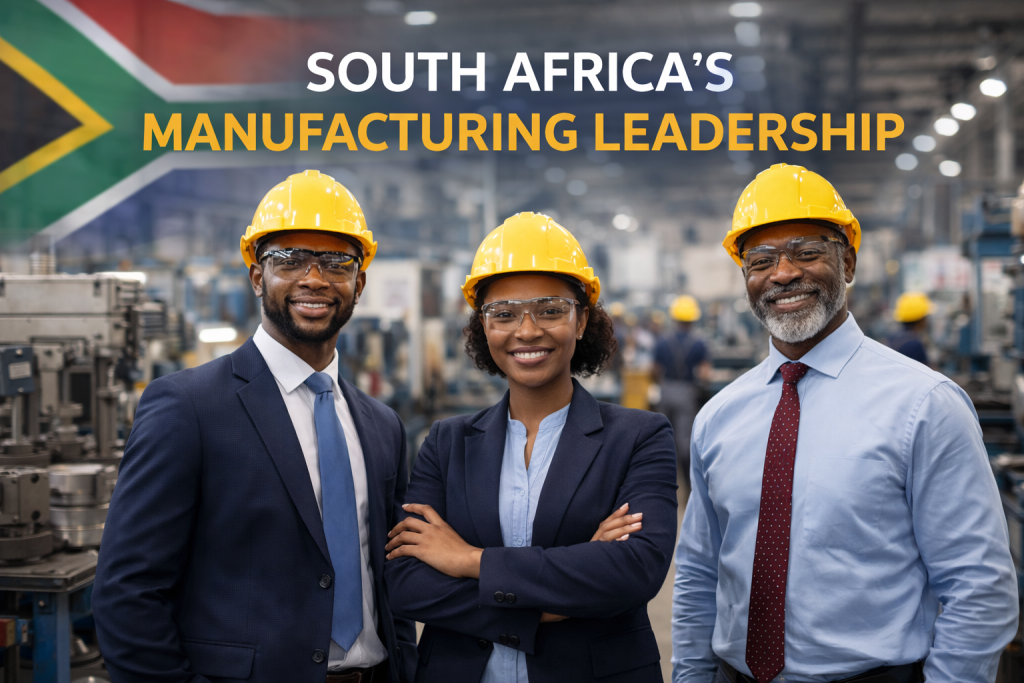
South Africa remains the most advanced manufacturing economy on the African continent. This leadership has been earned through decades of industrial depth, diversified production, and strong participation in global value chains, particularly across food and beverages, automotive, metals, petrochemicals, chemicals, and plastics.
Yet leadership in manufacturing is never permanent. It must be defended, renewed, and re-engineered.
Over the past decade, South Africa’s manufacturing sector has faced structural and external pressures that have steadily eroded its contribution to GDP since 2008. Rising energy costs, logistics bottlenecks, shifting trade dynamics, and sustainability regulations are reshaping the rules of competitiveness both regionally and globally.
The next chapter of South Africa’s industrial story will be defined not by what it has built, but by how deliberately it adapts.
The Current State of Play
Manufacturing in South Africa remains concentrated in a few dominant sectors. Food and beverages, vehicle manufacturing, and chemicals and plastics have increased their share of value-add and employment. Meanwhile, traditional segments such as metals, clothing, wood and pulp, and glass have declined in relative importance.
Geographically, the sector is also shifting. The Western Cape and KwaZulu-Natal have grown their share of manufacturing jobs, while Gauteng and the Free State have seen declines—reflecting changing infrastructure quality, logistics access, and regional competitiveness.
Despite its scale, the sector faces persistent challenges:
- High electricity costs have made heavy industry less competitive and reduced margins.
- Logistics and infrastructure constraints continue to undermine export efficiency.
- Illicit trade—both imports and local production—undercuts compliant manufacturers.
- Low GDP growth and high unemployment suppress domestic demand.
- Special Economic Zones and industrial masterplans have delivered mixed results.
- Higher tariffs relative to some trade partners limit export competitiveness.
- New US tariffs threaten manufacturers reliant on American markets.
At the same time, imports of manufactured goods have steadily increased over the last three decades, intensifying competition for local producers.
Why the Old Playbook Is No Longer Enough
South Africa’s industrial policy has placed strong emphasis on localisation. While well-intentioned, localisation without productivity gains can reduce competitiveness rather than enhance it. Protection alone does not build globally competitive manufacturers; efficiency, scale, technology, and cost discipline do.
Compounding this challenge is sustainability. South Africa’s manufacturing sector is carbon-intensive, making it increasingly vulnerable to global regulations such as the EU’s Carbon Border Adjustment Mechanism (CBAM). Carbon exposure is no longer an abstract risk; it is a direct threat to export access.
Leadership today requires more than production capacity. It requires future-readiness.
The Path Forward: Reinventing Leadership
To remain Africa’s manufacturing anchor—and outperform the next wave of industrial contenders—South Africa must pursue a more deliberate and modern strategy.
1. Decarbonisation as a Competitive Strategy
Green manufacturing is no longer optional. Investment in green hydrogen, electric vehicles, renewable energy inputs, and lower-carbon production processes will determine long-term market access. Sustainability is fast becoming a price of entry, not a differentiator.
2. Energy Self-Sufficiency for Industry
Manufacturers are increasingly sourcing embedded and renewable energy to stabilise costs and ensure reliability. This shift is becoming a core operational strategy, not a side initiative. Competitive manufacturing cannot exist without predictable power.
3. Smart Factories and Industrial Technology
Automation, robotics, AI, and IoT are reshaping factory floors. South African manufacturers are already moving toward smart factories to improve efficiency, reduce waste, and compete on cost and speed. Technology adoption must accelerate, particularly among mid-sized firms.
4. Redirecting Exports Toward Africa
With new US tariffs and shifting global trade dynamics, Africa presents a critical growth frontier. Proximity, trade agreements, and rising consumer demand offer an opportunity to rebalance export dependence—if logistics, standards, and regional integration are addressed deliberately.
5. From Protection to Productivity
Industrial policy must evolve. Anti-dumping measures and tariff protections may be necessary, but they must be paired with productivity incentives, infrastructure investment, skills development, and technology adoption. Competitiveness cannot be legislated—it must be built.
A Leadership Moment
South Africa does not need to reclaim its position as Africa’s manufacturing leader. It already holds it.
What it needs is to modernise that leadership; aligning industrial capacity with sustainability, technology, regional trade, and future skills. The countries that will dominate African manufacturing over the next 20 years will not be those with the most factories, but those with the most adaptive systems.
Manufacturing leadership is no longer about scale alone.
It is about resilience, intelligence, and strategic clarity.
South Africa has the foundation.
The next step is intentional reinvention.